
Part 2: Building a Handcrafted Business Advantages & Caveats
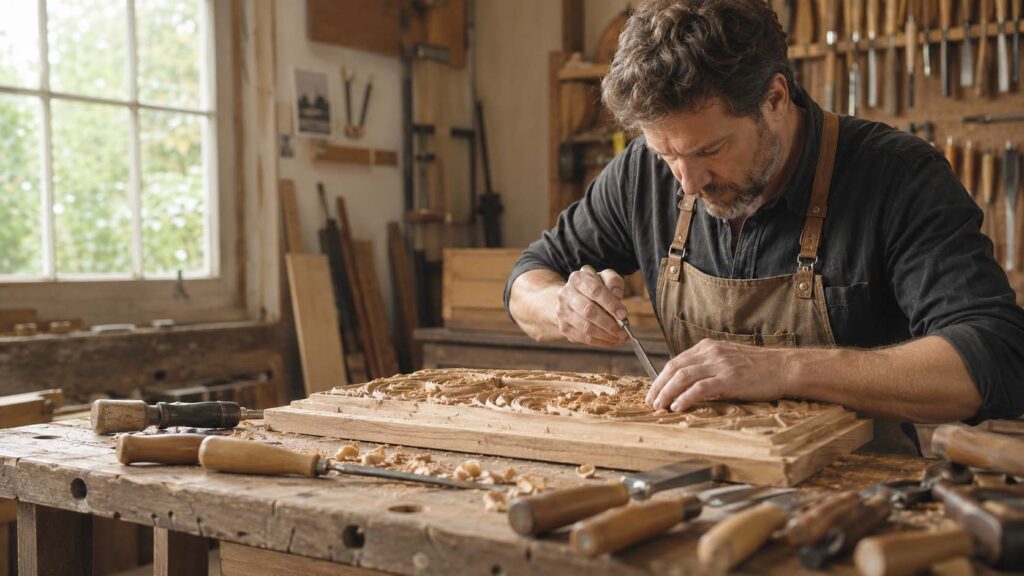
If part one was the why, this is the how. You believe in the work. You believe there’s something real happening when you make something with your own hands instead of pulling it off a container ship. Great. None of that pays the electric bill or buys groceries by itself. So let’s talk about actually running a business around handcrafted work in a market that’s simultaneously more crowded and more hungry for it than it’s ever been.
The Advantages You Actually Have
Your STORY does work that spec sheets can’t. Nobody’s emotionally attached to the fact that a mass-produced mug was injection molded in a facility that also makes forty other unrelated products. But “I make these one at a time on Tuesday afternoons, and I ruined my first six attempts before I got the glaze right” does something factory made never will. People aren’t just buying an object. They’re buying the story behind it, and handmade work comes preloaded with a story industry simply can’t manufacture, no matter how good their marketing is.
Trust is baked in, if you let it show. A customer who can see your hands in the work, literally see the small variations that prove a person made it, trusts it in a way they don’t trust something anonymous. This matters enormously for a values-driven customer specifically. Someone looking to support a Christian small business isn’t usually chasing the lowest price. They’re chasing something that feels honest, and handmade imperfection is often the clearest visual proof of honesty available.
You can say no to a race you were never built to win. You cannot compete with Temu or even Etsy on price. Don’t try. The businesses that survive this moment aren’t the ones matching mass production’s prices, they’re the ones who’ve made peace with charging what the work is actually worth and explaining why, clearly and without apology, instead of quietly resenting customers who balk at it. I’ve struggled with this myself.
The formula for retail price is your cost x 4.4. That’s it.
Cost x 2.2=Wholesale > Wholesale x 2.2=RETAIL. That is what your item should be priced at.
Your labor is your ideal hourly wage divided by how many you can comfortably make per hour. I typically make and label 5 perfumes per hour. I want to make $50 an hour, ergo my labor cost per item is $10.
I go over all these formulas and provide a free spreadsheet too for you in our FREE Ebook; The Faith Based Blueprint.
Pricing is genuinely hard, and most handcrafters underprice by a lot. This is close to universal. People who make things by hand tend to badly undercount their own time, pricing as if their hours are worth nothing, then wonder why the business never quite breaks even. If you haven’t done real, honest math on materials plus actual hourly time plus a fair margin, you’re probably charging less than the work is worth, sometimes by a wide margin.
You have permission NOT to scale or wholesale.
Scaling breaks the thing that made it special in the first place. I went viral in 2021 and made $40k in one weekend. It was the most miserable month of my life. 16-20 hour days for 22 days straight. Thank God I had my husband to help. The moment demand outpaces what your two hands can physically produce, you hit a real fork.
If hire help and risk losing some of the “made by one specific person” quality that justified the price or you’re like me and can’t hire another you. The option is to stay small and cap your income on purpose. Neither answer is wrong, but pretending you can scale infinitely while keeping everything exactly the same by hand is how a lot of handcrafters burn out trying to fulfill orders at 1am.
For me I stay small. It allows me to homeschool our daughter, be active in church and contribute in the way I desire to in my home. That’s ok, it’s what works for me.
The Social Media Trap
Filming and documenting your process takes almost as much skill as the craft itself now. Handmade work sells today largely through process, photos and video of the actual making, not just the finished product sitting on a white background. If you’re not someone who naturally wants to film or photograph your own process, this can feel like an entirely separate, unwanted job stacked on top of the actual craft.
Show the mess, not just the polish. The failed batch, the reworked prototype, the hands actually covered in whatever you work with. That’s the part a factory can never show, because there isn’t one.
Say the quiet part out loud in your marketing. “Made by hand, in small batches, by one person” isn’t bragging, it’s simply true, and it’s the exact information a values-driven customer is actively looking for before they buy.
Let your faith show up as craftsmanship, not just as a tagline. A well-made product says more about your convictions than a Bible verse printed on the packaging ever will. Excellence itself can be a form of witness, quietly, without needing to explain itself.
You Don’t Have to Figure the Business Side Out Alone
Making the thing might be the part you love. Photographing it, pricing it, building a brand and a website that actually communicate why it’s worth what you charge, that’s a different skill set entirely, and it’s exactly the kind of thing we help handcrafters figure out. We’re both Christians and handcrafters, we get it. If you’re doing genuinely good, meaningful work with your hands and the business side of it feels like it’s holding you back, we’d love to talk.
Let’s Talk
Get your FREE Ebook; The Faith Based Blueprint.





One Comment